Metallised polymer shielding housings for constellation-scale satellite RF systems
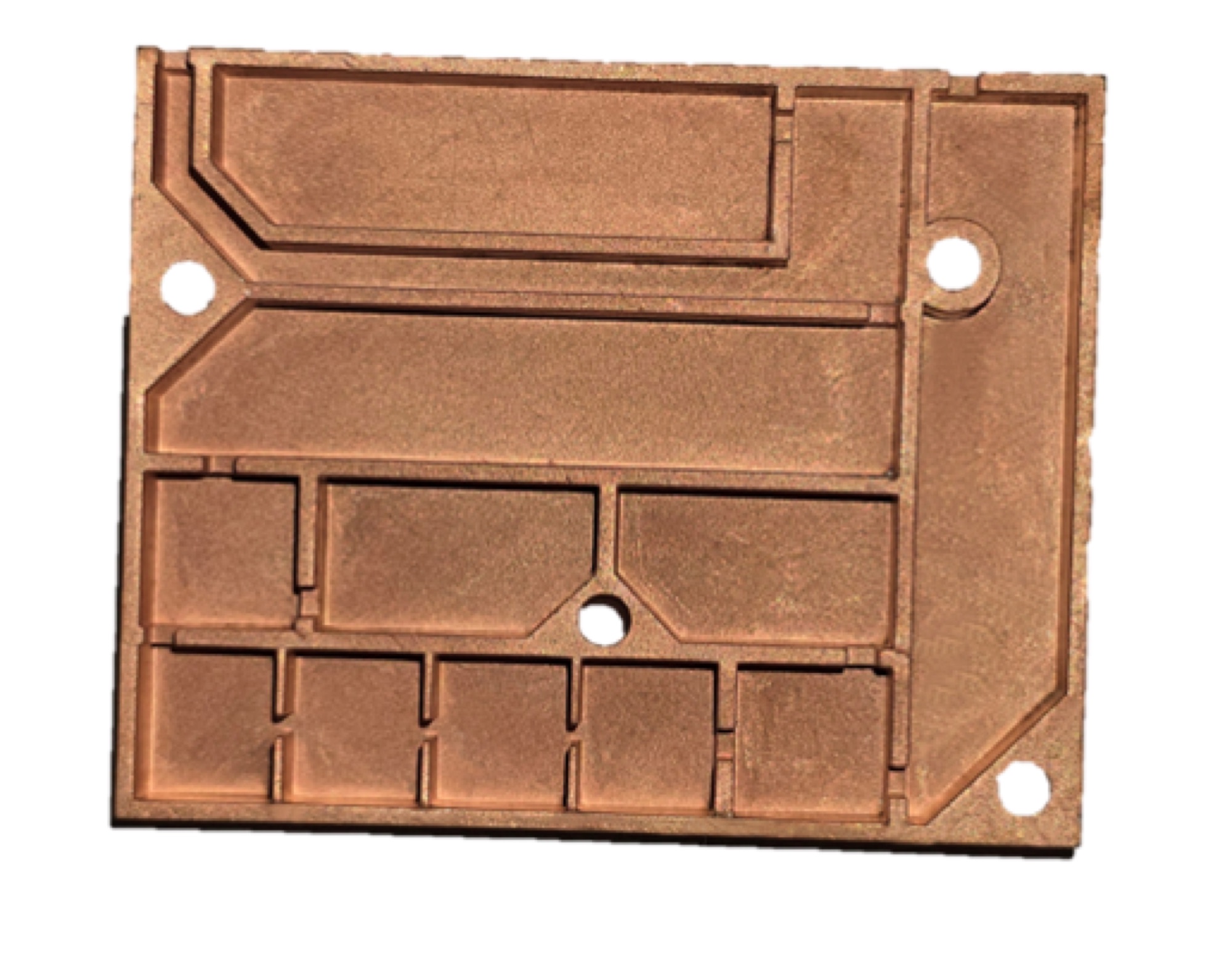
Phased-array antenna architectures can require shielding housings and related passive RF components in very high volumes. Horizon’s approach creates the precision housing geometry in lightweight polymer and adds a thin conformal metal layer to provide the required conductivity and shielding performance. This combines reduced mass and design freedom with a manufacturing route designed to move from prototype to series production.

The shielding housing challenge
Shielding housings are not usually regarded as the glamorous part of an RF payload, but considerable system intelligence can be engineered into them. They provide electromagnetic shielding and separation, accommodate sensitive electronics and RF functions, establish critical interfaces and contribute directly to achievable packing density and overall payload mass.
Their geometry, dimensional accuracy and assembly tolerances can therefore affect shielding effectiveness, integration and manufacturability. In phased-array architectures, where similar or identical housings may be repeated in very large numbers, relatively small component-level effects can quickly become programme-level issues.
When one housing becomes thousands, or tens of thousands, every gram, every assembly step, and every euro matters. Conventional all-metal approaches can be entirely feasible for many designs, but they can also introduce weight, machining cost, procurement lead time, and scalability constraints.
Horizon’s approach
Horizon prints the precision housing in high-performance polymer and applies conformal metallisation to provide the required conductivity. Metal is used only where its properties are needed, rather than throughout the entire component.
The resulting component can combine low mass, complex geometry, conductivity and space-relevant robustness within a single manufacturing route.
Customer benefits
- Reduced mass and lower payload SWaP burden compared with all-metal housings.
- Design freedom for compact and integrated geometries.
- Thin walls and fine geometries that challenge conventional machining.
- Metal surface functionality without defaulting to bulk-metal parts.
- A route from prototype to repeat production without changing manufacturing method and materials.
- A strong fit for constellation-class volumes.
- LEO-relevant pre-qualification as a head-start for development.
Designed for constellation economics
Horizon is developing this manufacturing route to remain economically competitive when programmes move from small series into thousands or tens of thousands of components. Printing, coating and verification are therefore being industrialised around repeat production rather than treated simply as processes for demonstrating individual parts.
This is particularly important for repeated hardware in constellation and phased-array architectures, where seemingly modest savings in component mass or unit cost can multiply into substantial programme-level benefits.
Qualification-led development
Horizon’s shielding housing work is supported by a space-relevant qualification track record for metallised polymer micro-AM demonstrators. Testing has addressed outgassing behaviour, temperature shock and cycling, radiation exposure, mechanical shock, atomic-oxygen exposure and coating/interface integrity.
Together, this work provides a credible starting point for application-specific qualification, with final part-level acceptance defined by the mission environment, component geometry and customer programme requirements.
Have a shielding housing challenge? Send Horizon the geometry and the target requirements. We will help assess whether metallised polymer micro-AM can reduce mass, simplify the design path, or support a more scalable route to production.