Passive RF components for space — lighter, smaller, more manufacturable
Horizon supports the development and production of passive RF and mmWave components where geometry, surface finish, conductivity, and weight all matter. By combining polymer micro-AM with conformal metallisation, Horizon enables RF structures that can be difficult, slow or uneconomic to manufacture using conventional routes.
Polymer micro-AM allows CAD- and simulation-led RF concepts to move rapidly into precise, metallisable physical components without the need for hard tooling or lengthy conventional manufacturing cycles.
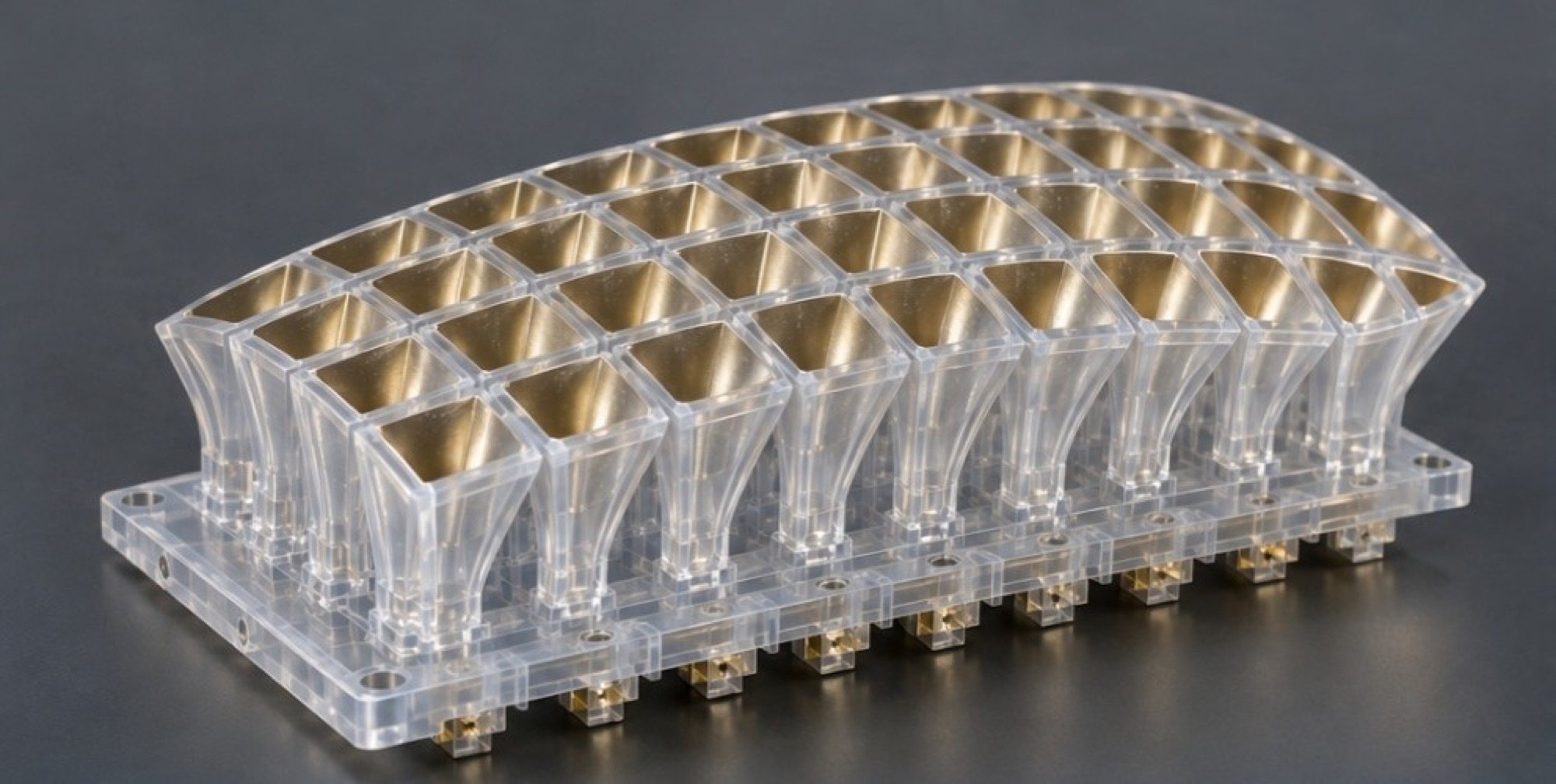
Component families
- Shielding housings and RF enclosures Lightweight shielding, packaging and electronics-adjacent structures, particularly where repeated components amplify mass and cost.
- Antennas and waveguide feed structures Selected RF architectures where Horizon can reduce mass and assembly complexity and (co)design or redesign the geometry around the advantages of polymer micro-AM and conformal metallisation. The objective is to retain the required RF function while creating a geometry that can exploit the weight, manufacturing and integration benefits of Horizon’s process.
- Filters Compact RF/mmWave structures where precision, surface quality, mass and manufacturing economics are important.
Why Horizon for passive RF hardware
At RF and mmWave frequencies dimensional accuracy and roughness of internal features is measured in microns. Together with the metallisation quality they critically influence performance.
Horizon brings the creation of an accurately manufactured polymer part and its functional metallic surface into an integrated component-development and production route, combining precision polymer micro-AM, conformal metallisation, protective coatings, application engineering and space-relevant test evidence.
From printed geometry to functional RF hardware
3D printing a component in polymer is the start of Horizon’s manufacturing process. Then, highly conductive metallization and protective coatings that have been designed and tested for space requirements are applied. This becomes particularly valuable where a component needs precise three-dimensional geometry and a conductive RF surface, but gains little from being solid metal throughout.
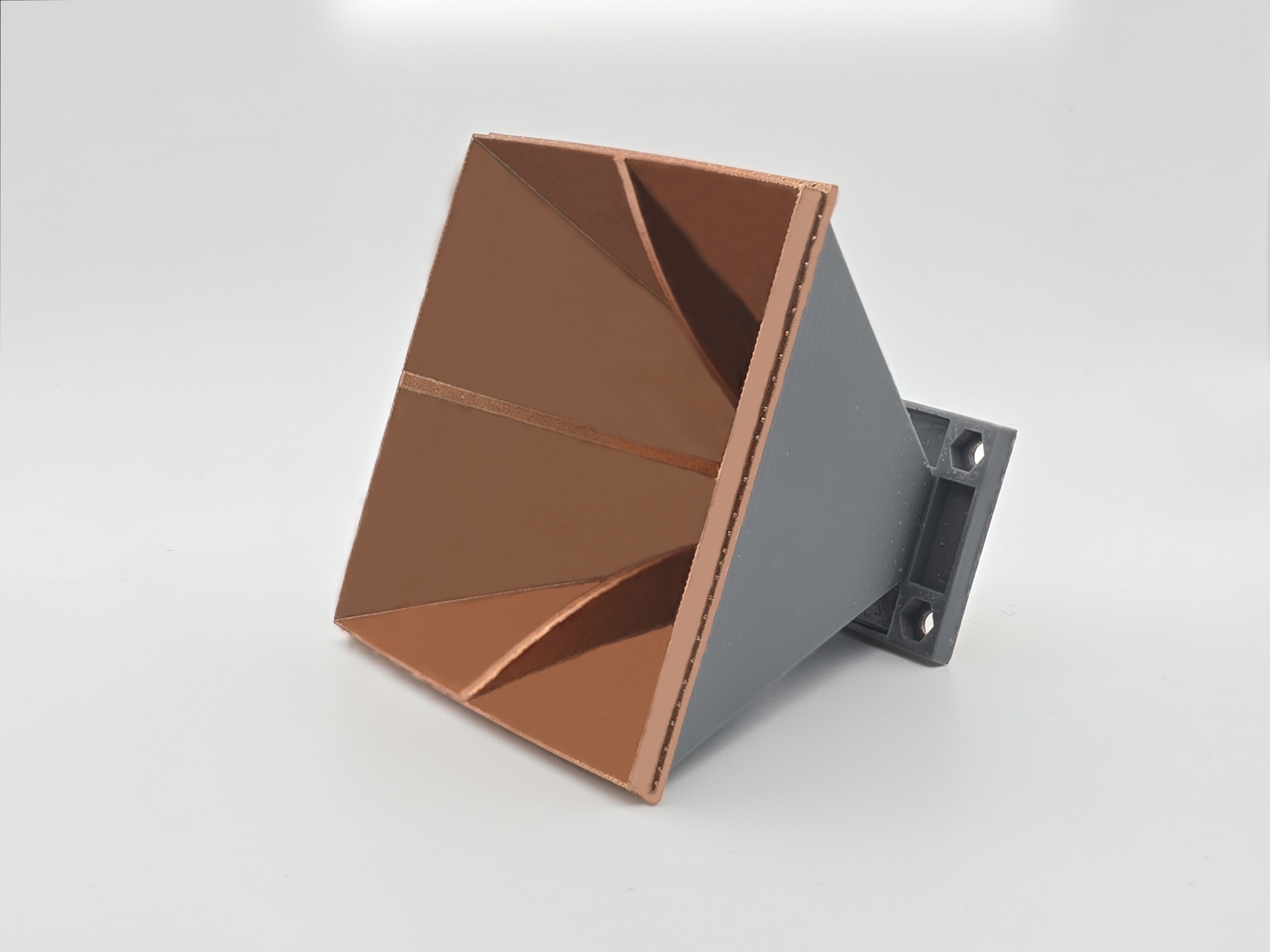
Where the approach becomes interesting
Horizon’s route becomes particularly relevant where low mass has system value, geometry is difficult or expensive to machine, thin walls or intricate features are desirable, designs are still evolving, or eventual production volumes make conventional metal-component economics unattractive.
It can become especially powerful where Horizon can co-engineer the component rather than simply reproduce a geometry originally designed around conventional metal machining.
These are not rigid selection criteria. They are useful starting points for exploring whether a different material and manufacturing architecture can improve the component.
Bring Horizon into the design conversation. Share the aspects that are already set: RF function, target frequency range, operating environment, expected volumes and/or current manufacturing constraints. Then let our team work with yours to develop a component architecture around what the part needs to do — rather than simply reproducing an existing metal geometry in another process.