Space Qualification Whitepaper

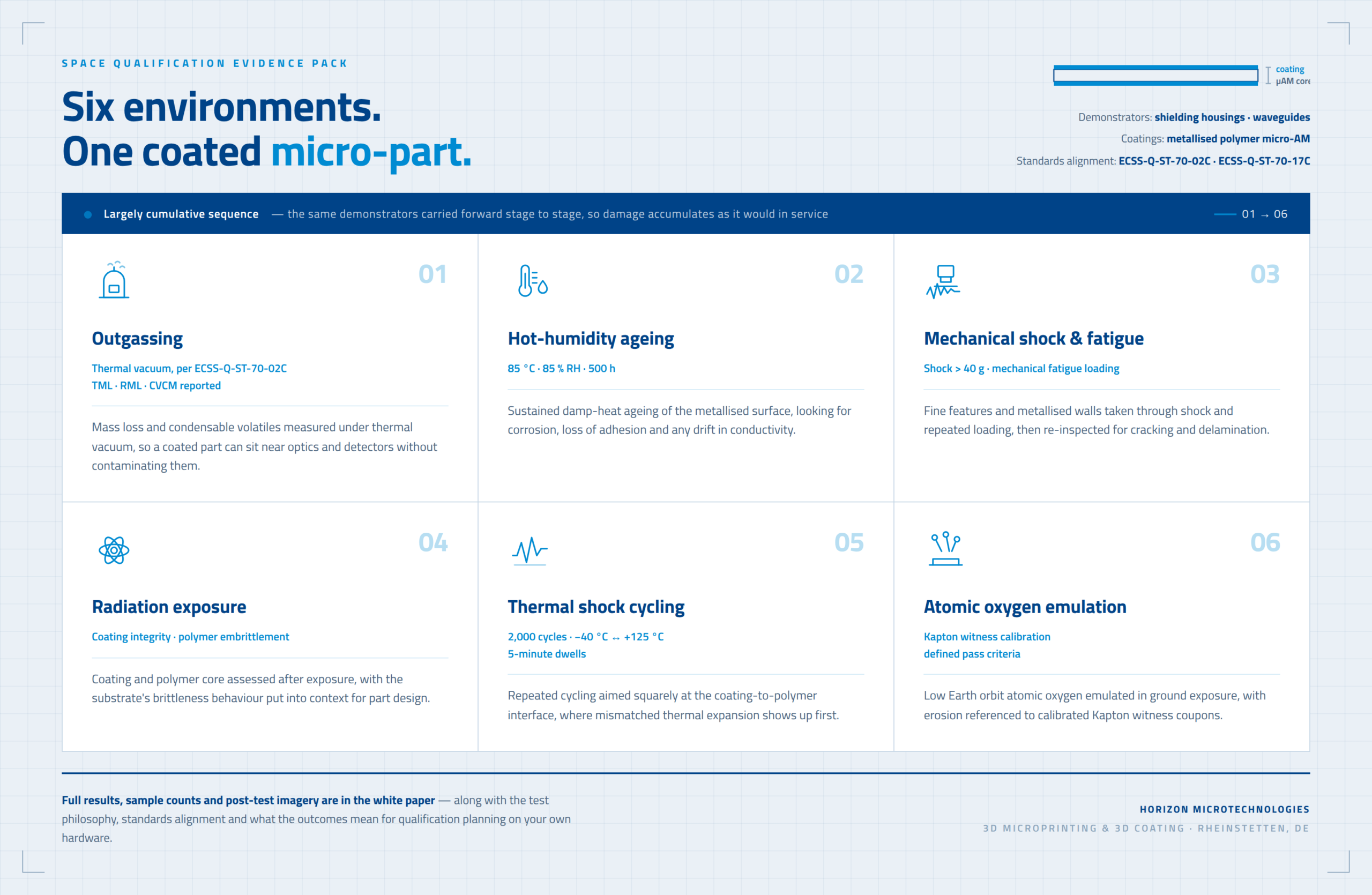
This white paper documents Horizon Microtechnologies’ space qualification campaign for metallised micro-AM polymer components. It explains the test philosophy (representative demonstrators, largely cumulative sequencing, standards alignment) and summarises results across key stressors (outgassing, hot-humidity ageing, mechanical shock and fatigue, radiation exposure, thermal shock cycling, and atomic oxygen emulation) showing how coated polymer parts can be credibly evaluated for harsh LEO-relevant environments and de-risked for adoption in other high-reliability systems.
What's inside

  • Why metallised micro-AM matters for space hardware: weight savings, design freedom, functional integration
  • The campaign objectives: proving reliability (not “science for science’s sake”) and benchmarking against established expectations
  • Methodology: representative demonstrators (shielding housings, waveguides) and largely cumulative test sequencing
  • Standards used and how they were applied (incl. ECSS-Q-ST-70-02C and ECSS-Q-ST-70-17C)
  • Results summary:
    • Outgassing (TML/RML/CVCM)
    • 85/85 hot-humidity ageing (500 h)
    • Mechanical fatigue + >40 g shock behaviour
    • Radiation exposure outcomes (coating integrity + polymer brittleness context)
    • Thermal shock cycling (2,000 cycles, –40 °C ↔ +125 °C, 5-minute dwells)
    • Atomic oxygen emulation outcomes (Kapton witness calibration + pass criteria)
  • What the results mean for real hardware design and qualification planning
  • Relevance beyond space: avionics, radar/5G/6G front ends, test & measurement, defence electronics
Enquire Now